
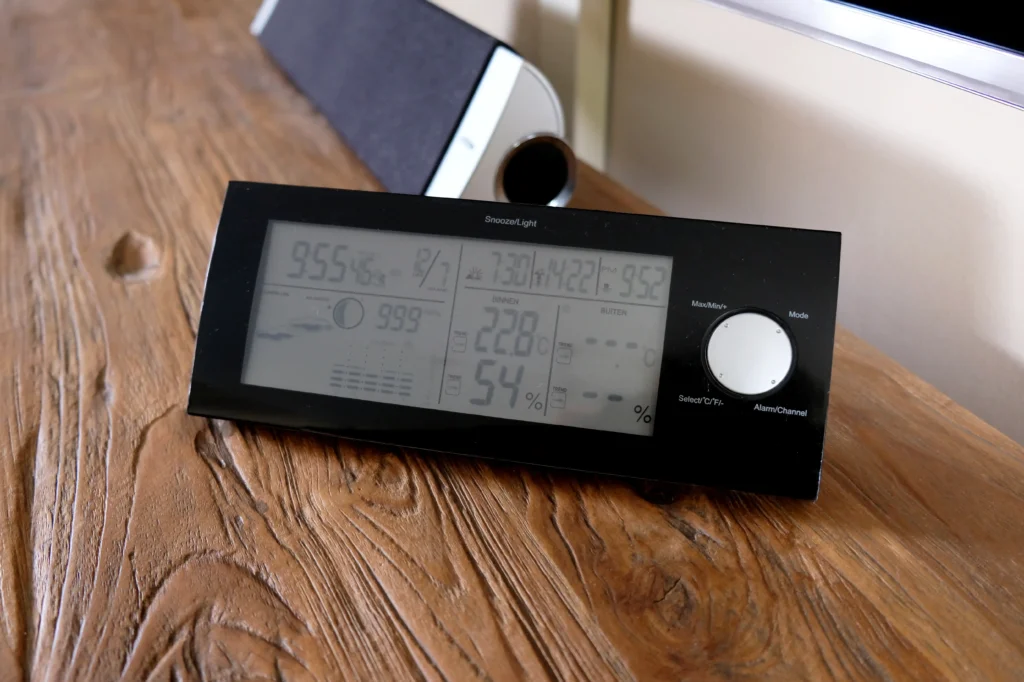
Unfortunately, humidity in the home is often overlooked or not monitored. It is extremely important for wooden furniture, floors, window frames, and, of course, most importantly, your own health. A pleasant indoor climate is largely determined by the humidity in your home. If it is too high or too low, you may experience health problems or damage to your home.
What is humidity?
Humidity is calculated based on the amount of water vapor in relation to the air. Temperature and air pressure also play an important role. Warm air can absorb more water vapor than cold air, for example. Humidity is expressed as a percentage (%). The higher the percentage, the more water vapor is present in the air. The ideal humidity in your home is between 45 and 65% on average.
The ideal humidity
For teak furniture as well as other wooden furniture, it is extremely important to strive for the ideal humidity level, not only for health reasons. TEAK2 therefore always recommends placing a hygrometer in your home so that the air quality can be monitored at all times. Based on these measurements, you can then take the necessary steps to achieve the ideal air quality.
Too low humidity
Nowadays, low humidity is most common in most (new) homes. Every home is insulated as well as possible, laundry is no longer dried indoors, dishwashers are used, and many other small things. Low humidity usually occurs in our homes during the winter, when the cold outside air and wind reduce the amount of moisture in the air. Turning on the heating or stove exacerbates this effect. Dry air can also occur in the summer, for example in a conservatory or through large windows where the warm sun shines in.
Some symptoms of excessively dry air are:
- Cracks in woodwork (furniture, window frames, floors, etc.)
- Dry eyes
- Cracks in the lips
- Irritation of the airways or mucous membranes (tickly cough)
- Fatigue, headaches and difficulty concentrating
Excessive humidity
Excessive humidity in the home can cause mold. Wooden furniture, window frames, and floors expand when they absorb moisture. Prolonged exposure to high humidity can lead to mold growth and a musty odor. Mold can cause health problems for residents, such as respiratory problems and allergies.
Impact of humidity on (wooden) furniture
Low humidity is the biggest problem for wooden furniture. The wood starts to shrink due to dehydration, which can cause cracks and splits. Although TEAK2 uses the highest quality teak, this remains a typical characteristic of wood. During the production process, every effort is made to limit this. The teak tables can shrink and expand thanks to a metal strip on the underside, a unique gluing process, and other small methods. The same applies to the cabinets; each panel can expand or shrink because it is not fixed to the frame. In addition, the teak wood is always first placed in drying chambers in Indonesia, giving it the ideal moisture content for shipping.
TEAK2 mainly uses old teak or recycled teak, which is less prone to cracking than plantation teak or new wood. Recycled teak or old teak has a much more solid structure; it is old and has experienced different living conditions, making it much stronger. There can be significant differences in the quality of teak wood. It is therefore essential to compare different furniture stores and their teak furniture honestly.
Wood is very strong, but when it expands or shrinks too quickly or too abruptly, cracks can form. This has no adverse effects and can always be resolved by re-gluing or using liquid wood. Like any other furniture store, TEAK2 is not liable for this. We cannot be held liable for products that have been damaged by temperature fluctuations or incorrect humidity in the home. Wood is a natural product and will expand or shrink depending on humidity in the wrong conditions. We therefore always recommend installing a hygrometer in your home. This is not only important for all wooden products such as furniture, window frames, or floors, but is also highly recommended for your health. You can buy a hygrometer for just a few dollars and monitor the humidity in your home.
Solutions for achieving good humidity levels
A hygrometer is a simple device for monitoring humidity levels. If the humidity is too low, it is advisable to purchase a humidifier. These devices are available from any electronics store and there is something to suit every budget. There are also special humidifiers that measure the humidity and automatically switch on to maintain the humidity level. A cheaper but commonly used method is to hang open containers of water on the radiator. The heat causes the water to evaporate and the air to become more humid. In practice, this is certainly not the ideal solution, as very little water evaporates in this way.
Is the air in your home too humid? This can be easily solved by opening the windows every day, using the extractor hood when cooking, etc. Good ventilation is essential here. An air conditioner also dehumidifies the air by removing moisture to cool it down.